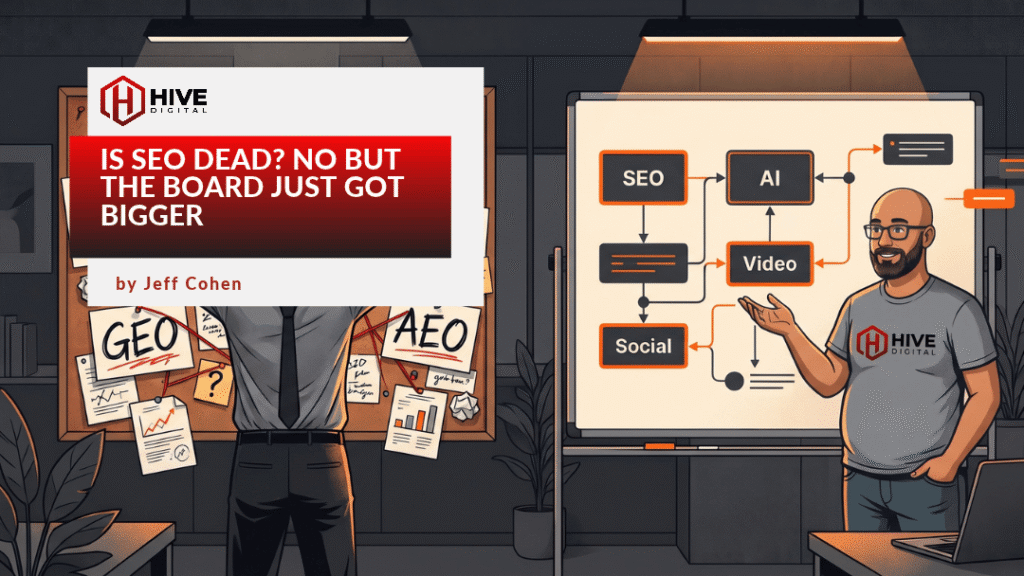
Every time a new search feature rolls out or a fresh marketing acronym hits LinkedIn, half the industry declares SEO dead while the other half starts looking like Charlie from It’s Always Sunny in Philadelphia, frantically tying red strings across a corkboard.

The “SEO is Dead” Conspiracy
It is easy to see why people feel overwhelmed. Between AI Overviews, ChatGPT, social discovery, and a growing alphabet soup of acronyms, GEO, AEO, AIO, the classic playbook of chasing ten blue links feels cramped.
At the recent Tech SEO Connect conference in Durham, NC, I spent two days listening to engineers and practitioners break down how modern search actually operates under the hood. There were several standout speakers across the lineup, and a few sessions in particular, especially talks from JP Sherman at Red Hat and Anfal Siddiqui at Google DeepMind, that I found helped to present a much more grounded reality.
The big takeaway… SEO isn’t dead. Single-channel thinking is.
What does that mean? The Search Visibility game didn’t end; we just have more opportunities on the board now.
TL;DR: Key Takeaways
- Single-Channel Searching Is What Actually Died: Treating your website in a vacuum ignores how modern buyers actually discover and validate brands.
- AI Search Is a Branding Channel: Judging zero-click AI interfaces purely on direct referral traffic misses their primary value, creating search demand upstream.
- Technical SEO Is Still a Key Foundational Piece: AI retrieval systems still depend on cleanly indexed, well-structured websites to pull candidate answers.
- LLMs Still Need the Open Web: Even top-performing AI models struggle with their parametric limits and factuality and rely heavily on verifiable web content to ground their answers.
- Video and Social Feed Search: Modern user journeys span many different routes. From streaming, scrolling, shopping, and searching, making off-site video and social platforms a direct driver of search visibility.
The Acronym Wars and the Single-Channel Trap
If you spend enough time in marketing circles, you will watch grown professionals argue for hours over whether our work should be called SEO, GEO, AEO, or “Relevance Engineering”.
During his session at Tech SEO Connect, Michael King (Founder and CEO of iPullRank) offered a blunt reality check on that exact debate. Fighting over labels confuses businesses and keeps search marketers stuck at what he called “the little kids’ table”. Executives do not care which three-letter acronym you put on a slide deck. As King put it, “CMOs don’t need a better SEO. They need a marketer that understands machines”.
That shift in perspective also clears up the panic around zero-click search. When studies show that referral traffic from standalone AI platforms is still small, and zero-click rates range anywhere from 34% to 93% depending on the channel, old-school SEOs tend to write AI search off as a distraction. King argued that judging AI Overviews or ChatGPT purely as direct-response traffic engines is a category error. They function as branding channels. They put ideas and brand names into a buyer’s head that create the search volume you capture later.
I’m sure all the people selling billboards and radio ads are laughing at us digital marketers now, since they’ve been dealing with soft data points for years.
We are also entering what King termed “machine media”. AI bot traffic has already surpassed human traffic, meaning bots are now arbiters of demand that gather, interpret, and remix web content on a user’s behalf. You cannot win in that environment by tweaking three keywords on a single landing page. Brand, video, social, digital PR, and search teams have to organize around actual buyer journeys rather than isolated channels.
Why Technical SEO Still Helps the Machine
One of the biggest myths fueling the “SEO is dead” crowd is the idea that generative AI has made traditional technical SEO obsolete.
JP Sherman (Principal Product Manager of Search at Red Hat) delivered one of my favorite sessions of the conference, walking through Reciprocal Rank Fusion (RRF)—the retrieval math search systems use to merge exact-word matches, semantic vector meaning, and rerankers across multiple fanned-out subqueries. Even when a system fans a single prompt out into dozens of candidate spots across multiple indices, Sherman made one rule crystal clear: “classical technical SEO is the gate”. If your content isn’t cleanly crawled and sitting in the search index, it never even enters the retrieval pool.
What has evolved is how those retrieved pages get evaluated. Sherman noted that modern search is less about holding a static ranking position and more about “deciding the answer to a question”. To explain how your site needs to adapt, he used an analogy that every content team should adopt: a URL is no longer a single house sitting on a lot, it has been gentrified into an apartment building.
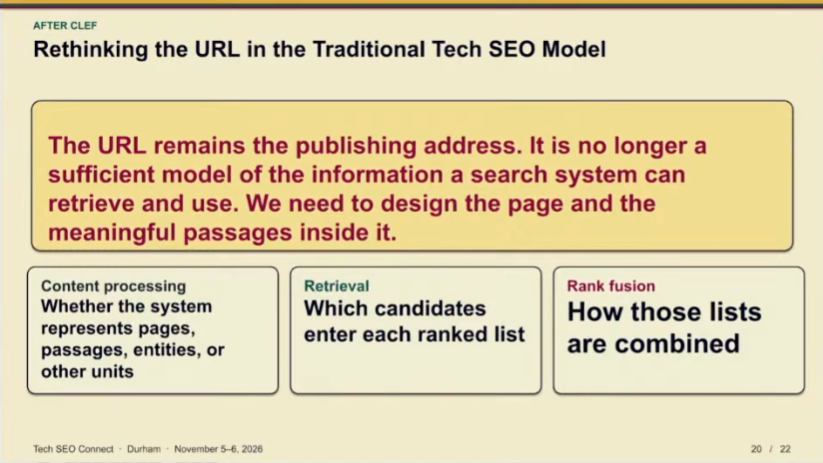
Instead of evaluating a page as one giant monolith, search and AI systems look at individual paragraphs, headings, images, and videos inside that URL as discrete passages that can be pulled out and quoted on their own.
Teachable Moment: JP Sherman closed his talk with a line worth keeping on your desk:
“AI in this case is the salt, it is not the meal”.
AI is a powerful layer added to how information gets retrieved and presented, not a replacement for the entire foundation. If your crawlability, information architecture, and content clarity are broken, no amount of AI buzzwords will fix your visibility.
Why AI Models Still Need the Open Web
The other major fear floating around boardrooms is that Large Language Models already “know everything” from their training data and will eventually cut websites out of the equation altogether.
But What if We All Stopped Posting New Things?
Anfal Siddiqui (Senior Machine Learning Engineer on Gemini at Google DeepMind) dismantled that assumption in another standout talk of the event. Siddiqui co-authored the FACTS Benchmark Suite, a public leaderboard designed to measure LLM factuality across four distinct dimensions: parametric knowledge (what the model knows from memory), search, multimodal (interpreting images), and grounding (sticking strictly to a provided source document without hallucinating).
Because “the answer has become the destination”, meaning users rarely click through an AI Overview to verify claims, factuality matters more than ever. Yet Siddiqui shared a sobering reality check from the benchmark results: even the highest-performing model on the leaderboard scores around 75% overall. As he pointed out, “in school, that would be a C”. On the multimodal image slice, even leading models still sit around 50% accuracy.
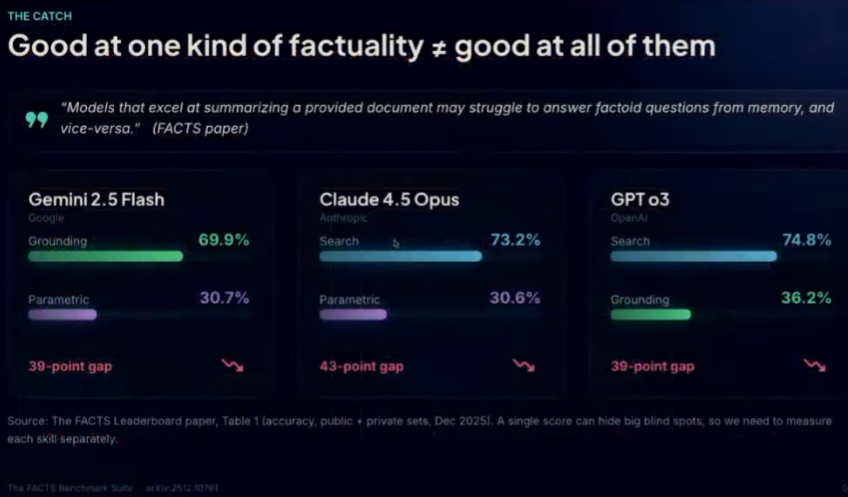
Furthermore, model capabilities don’t always improve in a straight line; newer releases can occasionally regress on specific factuality tasks. Because factuality is far from solved, LLMs cannot rely solely on internal memory. They depend heavily on search tool calls and clean, unambiguous web content to ground their responses. Your website isn’t obsolete, it is a verifiable piece of the evidence layer the machine relies on to avoid making things up.
Connecting the Rest of the Board: Video and the “Four S’s”
If technical SEO is the gate and verifiable web content is the evidence layer, video and social platforms are the red strings connecting the rest of the corkboard.
Cindy Krum (Founder and CEO of MobileMoxie) broke down why clinging to a linear website funnel leaves massive visibility on the table. She pointed to a 2025 Google and BCG study showing that modern online behavior breaks down into what Google calls the Four S’s: Stream, Scroll, Shop, and Search.
Every single one of those behaviors leans heavily on video:
- Video now accounts for 75% of mobile cellular data.
- 63% of consumers say they prefer learning about a new product through video.
- YouTube has overtaken Reddit as a top citation source for AI search, and 43% of AI Overview citations point back to Google-owned properties.
As Krum framed it, social video is “not SEO at the end. This is SEO at the beginning”. Short-form videos on TikTok, Instagram, and YouTube Shorts introduce ideas and brand names while people are casually scrolling, planting the exact concepts they later search for on Google. Meanwhile, clear, question-focused landscape videos on YouTube actively earn citations inside AI Overviews.
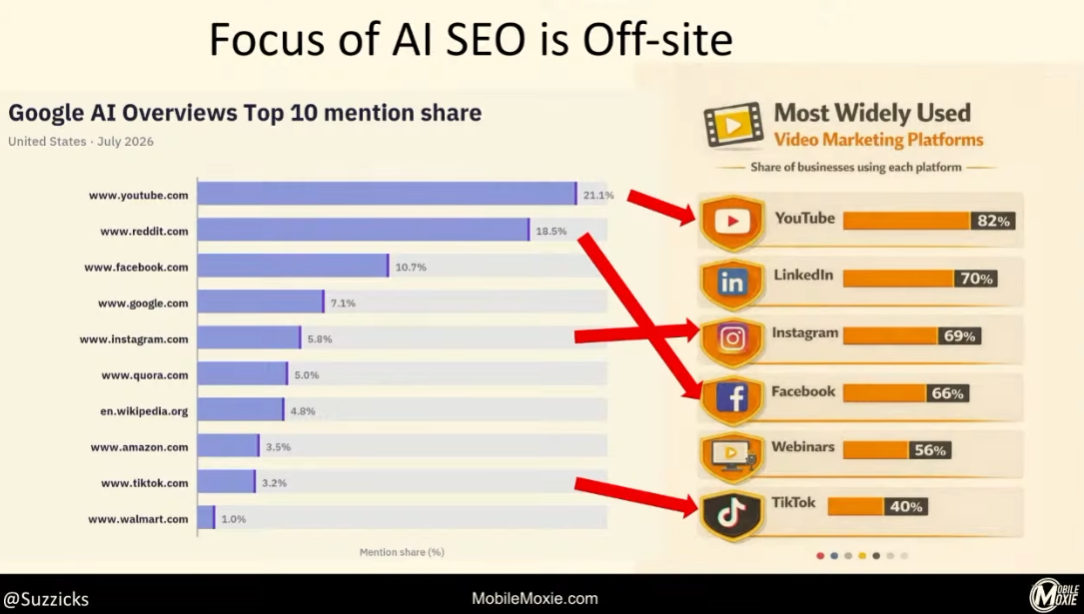
Pro-Tip: Connect the Strings Using Your Own Data Stop treating video, social, and SEO as competing budgets. Open Google Search Console, look at the pages and topics where you are already earning AI visibility, and turn those exact answers into concise, question-focused YouTube videos. Google already trusts your domain on those topics; adding video extends that trust into the formats users prefer to consume.
Playing the Bigger Board
Before stepping off the stage at Tech SEO Connect, Krishna Madhavan (Principal Product Manager at Microsoft AI) left the room with a reminder that cuts right through the industry panic:
“Remember that all of this is for humans… We need to build these systems in service of people, not the other way around”.
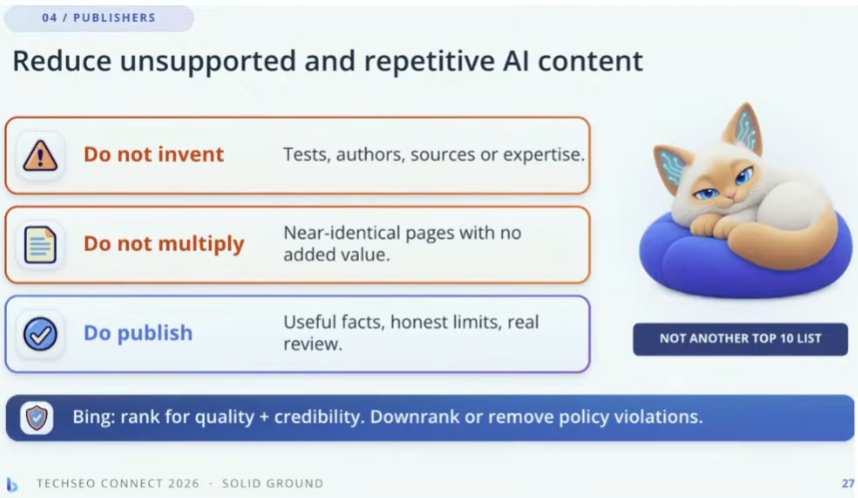
That is the antidote to the conspiracy board. SEO didn’t die, it just stopped living in a silo. But more importantly, it is still a key element of your overall marketing strategy when you pair solid technical foundations with clear, verifiable facts on your site and an active presence across video and social channels, every red string on the board leads straight back to your brand.
If your team is trying to figure out how traditional SEO, AI visibility, and video fit into one cohesive strategy, without chasing every shiny new acronym, let’s talk.
Reach out to us at Hive Digital, and we can help you map out the full board.