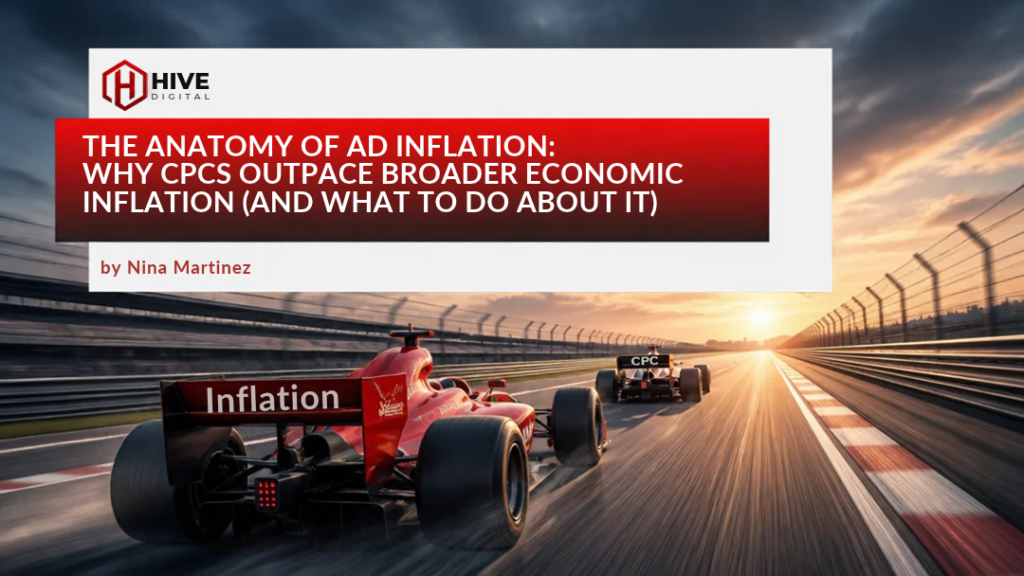
Ask almost any marketing director, business owner, or performance specialist about their top ad platform metrics today, and you will likely hear a similar frustration: the rising costs of advertising. Some may chalk it up to overall changes in the economy–but while broader economic indexes like the Consumer Price Index (CPI) show typical, fluctuating inflation rates within expected, single-digit ranges, digital advertising costs tell a very different story. For example, Cost Per Click (CPC) and Cost Per Mille (CPM) rates across major advertising networks like Google Ads and Meta (Facebook & Instagram) have consistently climbed at double-digit rates year over year, with cross-industry reports showing Google Search CPCs up 12% YoY and Meta average CPMs increasing up to 20% YoY.
For C-suite executives evaluating quarterly performance, the increases in costs conflict with the desire to manage advertising budgets in a way that aligns with overall national inflation, and raises questions. Why, in a time of national inflation that sits within a modest, single-digit range (generally between 2.5-4%) are digital acquisition budgets experiencing much higher, double-digit increases year over year–or rather, why are brands buying significantly fewer clicks than they did just two or three years ago with equal or even increased ad spend?
The short answer is that digital advertising operating costs aren’t guided by standard macroeconomic rules. They are instead guided by four factors: the mechanics of ad auctions, platform automation features, data signal shifts, and the competitive pressures on ad inventory. Understanding these four underlying drivers is the first step toward taking back control of your marketing acquisition costs and protecting your return on ad spend (ROAS).
Unpacking What Drives Digital Ad Inflation
To fix rising acquisition costs, we have to understand what is actually pushing ad prices higher. Unlike physical goods, for which supply chain logistics, labor costs, and consumer purchasing power drive cost, inflation in advertising costs stem from four platform-level dynamics:
Auction Density and Saturated Inventory
Digital ad networks act as real-time auctions; and as more businesses enter the digital space, competitive density increases. When twenty advertisers compete to bid on the same high-intent transactional search terms or attempt to reach the very same target audience on social media platforms, floor prices for ads naturally rise. Because high-converting inventory on mobile devices and desktops is finite, ad platforms monetize this high demand by letting auction competition drive up the cost of winning a click.
AI Bidding Automation and the “Black Box” Effect
Automated campaign types—such as Google Performance Max or Meta Advantage+—have fundamentally changed how ad budgets are spent. While machine learning succeeds at finding users at scale, the automated systems that power them rely on broad algorithms that are designed to optimize for total conversion volume rather than control unit costs. Left unconstrained by tight CPA (Cost Per Acquisition) targets or ROAS guardrails, these black-box systems will aggressively bid up competitive auctions to secure a conversion, driving market-wide CPCs higher for everyone in the pool.
Search Volume Compression and AI Overviews
User interactions with search engines are undergoing a major evolution. With the rise of AI-driven conversational answers and zero-click search results, casual informational queries are increasingly answered directly on the search engine results page (SERP). This compresses the total volume of clicks passing through to external websites. As top-of-funnel informational traffic shrinks, advertisers are forced to compete for a smaller, highly concentrated pool of lower-funnel, transactional queries—driving intense competition and elevated CPCs on those remaining conversion-focused terms.
Data Degradation and Signal Loss
The ongoing deprecation of third-party cookies, combined with heightened consumer privacy controls (like the Apple iOS tracking limits and/or browser-level blocking), has eroded traditional ad targeting precision. When ad networks have less visibility into user behavior, their algorithms must show more impressions to find users who are likely to convert. The loss of signal efficiency leads directly to higher CPMs and CPCs, as advertisers end up paying for the algorithmic trial-and-error required to match ads with the right audience.
Hive Marketing Services
Hive's team of expert digital marketers are ready to support you across the marketing mix. From SEO and paid advertising to social media management and data reporting, we're an extension of your digital team!
Discover HowDiagnostic Action Plan: How to Offset Escalating CPCs
While you cannot single-handedly change platform auction mechanics or the competition in broader markets, you are far from helpless. Mitigating ad inflation requires stepping away from buying cheap traffic and choosing to focus instead on building highly efficient, high-converting acquisition ecosystems.
1. Move Downstream with First-Party CRM Data
One of the most effective ways to counteract the rising cost of ads is to feed your ad platforms better conversion signals. Relying solely on top-of-funnel conversion events (like form fills or soft sign-ups) teaches ad algorithms to bid aggressively on low-quality leads.
By integrating your CRM—whether you use HubSpot, Salesforce, Pardot, or Zoho—directly with your ad accounts, you can pass offline conversion data back to platforms like Google or Meta. Optimization based on actual pipeline stages, qualified leads, and closed-won revenue ensures ad networks use their aggressive bidding algorithms to acquire high-value customers rather than high-volume noise.
2. Plug Post-Click Leaks to Protect ROAS
You cannot always control how much Google or Meta charges for a click, but you have absolute control over what happens after a user hits your website. Conversion Rate Optimization (CRO) is your strongest lever against ad inflation.
If your cost per click increases by 20%, but your landing page’s conversion rate improves from 2% to 3% through structured A/B testing, clearer messaging, and a user experience (UX) design that mitigates friction, your effective cost per lead actually drops. Improving website load speed, removing form friction, and using targeted landing pages that are designed specifically for your ad messaging ensures every ad dollar spent goes further.
Example Math:
- Scenario A: $10 CPC at 2% Conversion Rate = $500 Cost Per Acquisition (CPA)
- Scenario B: $12 CPC (Ad Inflation) at 3.5% Conversion Rate (CRO Optimized) = $342 CPA
3. Refine Match Types and Build Negative Keyword Defenses
Automated search campaigns love broad match terms because they offer expansive reach. However, without strict oversight, broad match keyword strategies often drift into irrelevant, low-intent search queries that burn through ad budgets without yielding conversions.
Protect your account by auditing search term reports regularly, building robust negative keyword lists, and making sure your budget is concentrated on high-intent query patterns. Treating negative keywords as a weekly account management practice prevents ad platforms from wasting your spend on non-converting auctions.
4. Cross-Channel Diversification
Relying entirely on a single ad network leaves your business highly vulnerable to sudden changes in platform policies or vertical cost spikes. Mitigate channel risk by evaluating alternative platforms where competitive density may be lower or audience targeting may be better aligned with your ideal buyer personas.
With B2B organizations, testing LinkedIn or Microsoft/Bing Ads can yield higher-quality, professional leads at a more consistent, stable cost structure. For B2C and direct-to-consumer brands, balancing paid search with YouTube Shorts, Connected TV (CTV), or targeted programmatic display can help to capture user intent–often before users actively enter search networks to type a high-cost, traditional search query bid up by competitors.
Reclaiming Efficiency in High-Cost Digital Auctions
Rising digital ad costs are an undeniable market reality, but escalating CPCs do not have to mean diminishing returns. Ad inflation simply penalizes passive account management and unoptimized user journeys.
The brands that thrive in high-cost advertising environments are those that stop viewing paid media in a vacuum. By combining disciplined search management, rich first-party CRM signal integration, and continuous post-click CRO testing, you can build a more resilient digital marketing engine that absorbs market cost pressures and delivers sustainable, long-term growth.
Is your paid media spend getting eaten up by rising ad costs without the revenue gains to match? Request a comprehensive Hive Digital Paid Media & Conversion Audit to uncover ad spend waste, identify points of friction on landing pages or in conversion journeys, or to restructure your bidding strategies for enhanced efficiency.