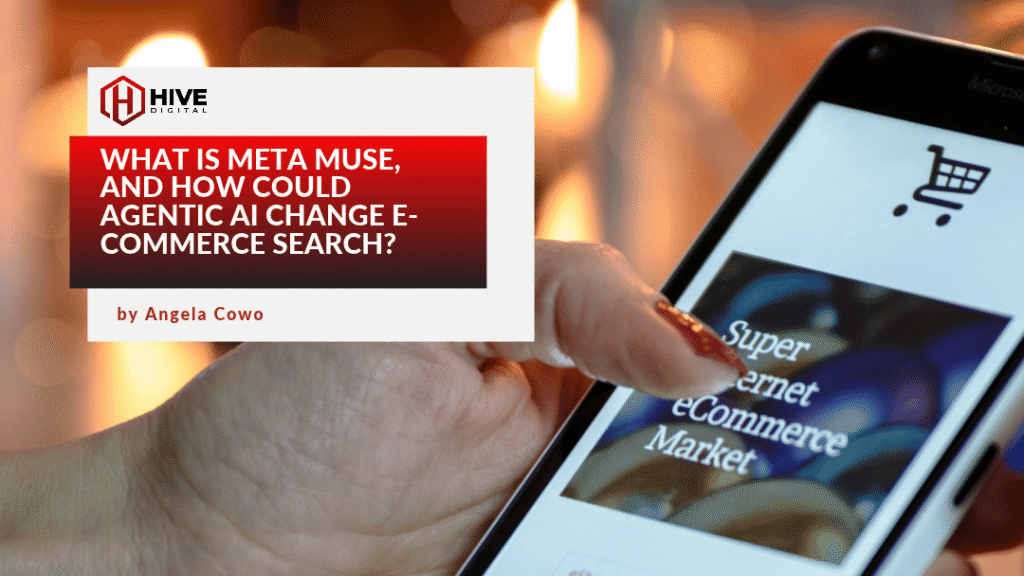
Think about the last time you shopped online for something specific. Chances are, you didn’t find exactly what you needed with your first search. You probably refined your search terms, compared a few products, checked reviews, and visited multiple websites before deciding what to buy.
Now imagine handing that entire research process over to an AI virtual assistant.
Congratulations! You’ve just taken your first step into the future. That’s the direction agentic shopping is heading, and Meta Muse is one example of the technology making it possible. Rather than relying on customers to conduct multiple searches themselves, AI assistants can research products, compare specifications, and narrow down options based on a single request.
For e-commerce businesses, this could change how potential customers discover their products. If AI is doing the searching, your website needs to provide the information these systems use to evaluate whether your products meet someone’s needs.
At Hive Digital, we’re particularly interested in what this means for SEO, product detail pages, and how businesses can prepare for a shopping experience where AI plays a larger role in the research process.
What Is Meta Muse?
Meta Muse is a personal AI assistant designed to help users complete everyday tasks, including researching products, comparing shopping options, and making purchases with user approval.
Unlike those regular chatbots you see on shopping sites that primarily respond to questions, Muse can interact with websites through a browser to gather information and assist with more involved tasks. For shoppers, this could mean providing a list of requirements and allowing the assistant to research available options instead of manually searching through multiple retailers.
This technology is part of a broader movement toward agentic commerce, where AI assistants take on more of the research and decision-making process involved in online shopping.
Stay on the Cutting Edge with AI Services
AI is changing the way people search, learn, and buy... Hive is ready for the digital evolution. Our team of expert AI engineers can help you stay visible in new search spaces like generative search engines and AI overviews. We can also help empower your business to use AI solutions for enhanced marketing efficiency and impact.
Discover Hive AI ServicesFor businesses selling products online, the important distinction is who is doing the research. Customers may still decide what to purchase, but AI assistants could increasingly handle the searches, comparisons, and product evaluations that lead up to that decision.
AI Shopping 101
- Agentic commerce: online shopping where an AI assistant handles steps the shopper would normally do, like searching, comparing, and checking out.
- AI shopping agent: an assistant, such as Meta Muse, that can browse retailer sites and act for the shopper, with their approval.
- Product detail page (PDP): the page for a single product, where its specs, price, variants, and shipping details live.
How Does Agentic Shopping Change the Research Process?
Imagine you’re shopping for a new carry-on suitcase. You want something lightweight, priced under $150, with four spinner wheels, a hard shell, and delivery before your upcoming trip.
Today, you might start by searching “lightweight carry-on luggage,” then narrow it to “hard shell carry-on under $150.” From there, you could search for specific brands, compare dimensions, read reviews, and check which retailers offer the delivery date you need.
That’s several searches, multiple website visits, and a fair amount of time spent researching one purchase. Another alternative is that you could look up a query such as “best carry-on suitcases”, which will give you multiple best-of lists that you still have to click on and search through.
What Is Agentic Shopping?
With agentic shopping, you could give an AI assistant all those requirements in a single request. The assistant could then conduct the research, evaluate available products, and compare options on your behalf.
| Shopper’s requirement | What the page needs to state | Example |
| Fits as a carry-on | Exterior dimensions, wheels included | 22 × 14 × 9 in |
| Lightweight | Weight in lb and kg | 6.2 lb (2.8 kg) |
| Four spinner wheels | Wheel count and type, written out | 4 × 360° spinner wheels |
| Hard shell | Shell material | Polycarbonate hard shell |
| Under $150 | Current price for every variant | $129.99, all colors |
| Arrives before the trip | Shipping options and delivery estimate | Free 3–5 day shipping |
The customer is still making the purchasing decision, but AI is taking over much of the research that leads up to it.
For e-commerce businesses, this changes how we need to think about product visibility. Your website may no longer be competing only for a shopper’s attention within traditional search results. It may also need to provide enough relevant information for an AI assistant to identify your products as suitable options.
That brings us back to the importance of product detail pages.
Why Product Detail Pages Matter When AI Is Doing the Searching
When a customer visits your website, they can browse product images, explore categories, read descriptions, and decide which features matter most to them.
An AI assistant approaching that same website may be looking for specific information to answer a shopper’s request.
What Do AI Shopping Assistants Look for on a Product Page?
Returning to our suitcase example, the assistant needs to determine whether a product meets several requirements. Is it lightweight? Does it have four spinner wheels? Is it a hard-shell model? Does it cost less than $150? Can it arrive before the customer’s trip?
If your product page only includes a general description, those answers may not be clear.
Teachable Moment: Read one of your product pages as if you couldn’t see the images. If the weight, dimensions, or materials appear only in a photo or a size-chart image, an AI assistant may have a harder time confirming them. Put them in the text too.
This is why we expect detailed, accurate product information to become increasingly important as agentic shopping develops. Clear specifications, product variations, availability, pricing, and shipping details help customers make informed decisions while also providing information that automated systems can use when comparing products.
From an SEO perspective, this reinforces many of the recommendations we already make for e-commerce websites. Product pages should be descriptive, accessible, and structured in ways that make important information easy to find.
The difference is that we’re no longer thinking exclusively about the person reading the page. We’re also considering whether an AI assistant can access and interpret the details needed to evaluate a product.
What Could This Mean for E-Commerce Discoverability?
One of the biggest potential changes is how the research process influences website traffic.
Traditionally, a shopper might perform five or six searches, visit several websites, and compare products before purchasing. Those interactions create opportunities for retailers to appear in search results and attract visitors at different stages of the buying process.
If an AI assistant handles that research instead, the customer may not need to visit as many websites or conduct as many searches themselves.
That doesn’t necessarily mean organic search becomes less valuable. It means the way products are discovered and evaluated could change.
An AI assistant might research multiple retailers, compare their products, and present a shortlist to the customer. In that scenario, having accurate, accessible product information becomes particularly important because the assistant needs to understand what you’re selling before it can determine whether your products meet the request.
Preparing Your E-Commerce Website for AI-Assisted Shopping
As agentic shopping develops, we expect the relationship between customers, search engines, and online retailers to continue changing.
The customer may still know exactly what they want, but AI could increasingly handle the research required to find it. Instead of manually conducting multiple searches and comparing products, shoppers may rely on assistants to narrow down their choices before visiting a retailer or completing a purchase.
Things to consider:
- Put key specs on the page as text, not only in images or PDFs.
- Show price, variants, and stock status clearly for each option.
- List shipping costs and delivery estimates on the product page itself.
- Keep product structured data and your Merchant Center feed matching the page. This is a natural spot to link the Merchant Center post.
- Check that bot-protection settings aren’t blocking the AI assistants you want to reach your site.
For e-commerce businesses, this makes it worth reviewing whether their websites provide the level of detail and accessibility these systems need.
Pro-Tip: Test it yourself. Give an AI assistant the kind of request your customers would make, such as “a hard-shell carry-on under $150 with four spinner wheels,” and see whether your products make the shortlist. For the ones that do, notice which details it pulls from the page.
At Hive Digital, we’re continuing to follow developments in agentic shopping and how they affect SEO, AI, product visibility, and the online purchasing process.
If you’re wondering how prepared your website is for these changes, explore our AI Search and LLMO services or contact our team to discuss your e-commerce AI strategy.