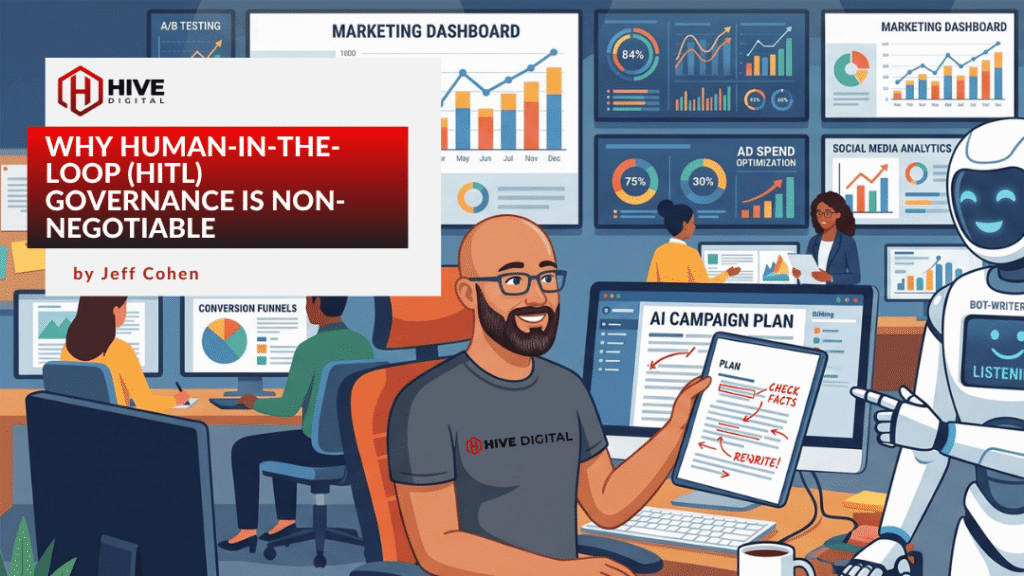
Why Human-in-the-Loop (HITL) Governance is Non-Negotiable
I remember one of the first times I thought a generative AI model was finally good enough to help me automate my workflow. I was working on a draft for a promotion landing page for a client’s latest service offering. I fed the AI my initial outline, the client details, the background info, and it spit out a highly readable, structurally sound draft in just a few minutes.
AI saved me hours of researching and writing… until I realized it didn’t.
When I actually reviewed the copy, the model had quietly invented several exaggerated product specs and also missed the grounded, B2B tone that we identified for their target audience. That was the moment it clicked: the real job of a modern marketer utilizing AI isn’t simply outsourcing the work to a machine; it’s managing the machine – and sometimes that can feel like a herculean task.
The “AI Slop” Antidote
As we integrate generative tools into our digital playbooks, we have to adopt consistent Human-in-the-Loop (HITL) governance. Handing the keys entirely over to an AI agent is a massive risk, and human oversight remains your biggest competitive advantage.
The Copywriter as the Governance Layer
The common misconception is that AI will simply replace writers. In reality, the role of a modern copywriter is evolving into something far more critical: the “governance layer.”
Think of it like a promotion, we all just got bumped up to Senior Editor. Congrats!
An AI agent is fantastic at aggregating data and building the initial scaffolding of an article or landing page. But left unchecked, it doesn’t take long before it produces “AI slop”, content that is grammatically flawless but devoid of unique insight, original thought, or factual grounding. A human has to be in the loop to transform that raw, generated material into a strategic asset.
Accuracy Verification and “Perception Drift”
AI tools are incredibly powerful and useful, but like any highly complex tool, they work most effectively when we humans understand how to use them and how to guide them.
Stay on the Cutting Edge with AI Services
AI is changing the way people search, learn, and buy... Hive is ready for the digital evolution. Our team of expert AI engineers can help you stay visible in new search spaces like generative search engines and AI overviews. We can also help empower your business to use AI solutions for enhanced marketing efficiency and impact.
Discover Hive AI ServicesThe classic adage “garbage in, garbage out” heavily applies here. If I don’t provide a full list of company details or product specs and just hope the AI tool will find it on its own, then the erroneous results are partly on me. We users need to continually review the outputs and refine our inputs to make the most of all that computing power.
What to Know: If you leave an AI to fill in the blanks without strict guidance, it will default to simply giving you something that “sounds good.” Without a human verifying every claim, your brand is highly susceptible to “perception drift.”
Perception drift happens when an AI subtly exaggerates specs, invents case study metrics, or misrepresents your service offerings. Over time, these small inaccuracies accumulate in your published content and slowly erode brand trust. A human must verify that an agent hasn’t invented claims just to fill a paragraph.
The Reply Bias Trap
We also have to account for the mechanical realities of the tool itself. LLMs are not oracles; they are algorithmic mirrors suffering from intense AI reply bias. Because these models are trained to be helpful and avoid friction, they have a sycophantic tendency to agree with whatever prompt you feed them.
However, we can’t simply blame the machine and assume it’s flawed. It is what it is, and we humans need to be held accountable here as well. We have to be mindful not to let our own conversational habits taint the inputs and outputs. If you provide a flawed marketing premise or a weak persona, the AI will confidently validate it rather than pushing back. HITL governance ensures that a human is there to force the pivot, challenge the AI’s output, and prevent our own echo chamber from dictating the digital strategy.
Strategic Refinement: The Senior Editor Role
Ultimately, integrating AI changes the day-to-day workflow from drafting from scratch to heavily editing. Copywriters and content marketers must now act as the “Senior Editor” for their AI agents.
- Brand Voice: AI tends to default to a sanitized, HR-department-style empathy. The human editor must inject the actual personality, grit, and unique perspective of the brand.
- Watch Your Wording: Depending on your subject matter, AI sometimes leans heavily into exclamatory, or purple prose. It may throw in some alarming words like “critical,” “essential,” or “dire.” Or in some cases everything suddenly becomes a “magical,” “harmonious” part of “your journey.” Here’s where you’ll need to get out your red pen and cut through these clichés.
- Emotional Depth: Generative engines do not have lived experiences. They cannot observe, feel, or relate. The Senior Editor must weave in the proprietary anecdotes, real-world analogies, and human nuances that actually resonate with the reader.
- Contextual Alignment: An AI doesn’t know if a joke lands or if a transition feels jarring. Human refinement is required before any agent-generated draft is published to live systems.
The Human Element is the Differentiator
The hype cycle wants you to believe that AI is a set-it-and-forget-it solution. The reality is that AI is just a very fast, very eager intern. It can do the heavy lifting, but it requires strict oversight, clear direction, and rigorous fact-checking. By establishing strong Human-in-the-Loop governance, you protect your brand’s integrity while still scaling your output.
If you are looking for ways to safely integrate AI tools into your marketing workflows without sacrificing your brand’s authority, our team is ready to help. Let Hive Digital partner with you to build a content strategy that drives real, verified results.