If there’s one question coming up in client conversations lately, it’s this:
“How much of my organic traffic is AI eating?”
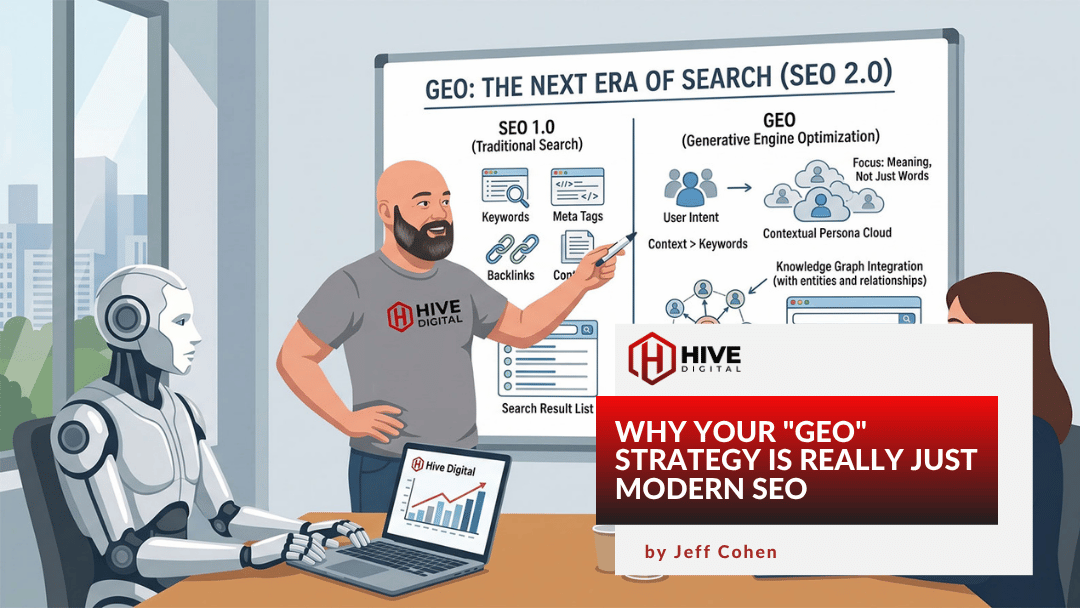
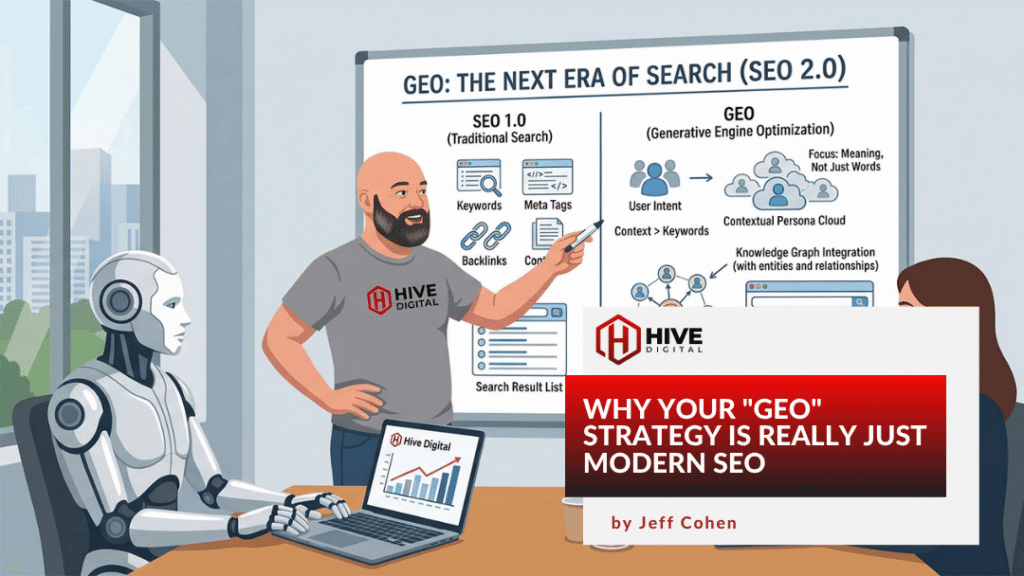
It’s a fair concern. With Google’s AI Overviews (AIOs), ChatGPT’s search experience, and platforms like Perplexity, the familiar “10 blue links” are getting pushed further down the page. At the same time, the industry has introduced a new acronym, GEO (Generative Engine Optimization), and with it, a lot of uncertainty about whether businesses now need an entirely new strategy (and budget) to optimize for AI instead of people.
But when you look at the actual data, the picture is more nuanced. Once again, reports of SEO’s demise are… premature.
What we’re seeing isn’t the end of SEO. It’s an evolution of it. And the smartest response isn’t to reinvent the wheel; it’s to make sure the wheel is built for how search actually works today.
The “Dark AI” Attribution Problem
Let’s start with the part that’s confusing everyone: analytics.
If you open GA4, you probably don’t see a meaningful spike in referral traffic from ChatGPT, Gemini, or other AI tools. In many cases, it looks negligible. That leads to the obvious question: Are people actually using AI to search?
They are. What’s missing is attribution.
When users click citation links inside secure AI interfaces, referrer data is often stripped for privacy reasons. When they land on your site, GA4 doesn’t know where they came from, so that visit ends up categorized as Direct or Unassigned.
Stay on the Cutting Edge with AI Services
AI is changing the way people search, learn, and buy... Hive is ready for the digital evolution. Our team of expert AI engineers can help you stay visible in new search spaces like generative search engines and AI overviews. We can also help empower your business to use AI solutions for enhanced marketing efficiency and impact.
Discover Hive AI ServicesAcross many client accounts, we’re seeing a gradual rise in those buckets. The traffic is there; it’s just harder to trace. AI-driven discovery is happening, but it’s largely invisible to traditional analytics.
A Shrinking Pie, Mostly at the Top
Even when clicks are harder to track, behavior still tells a clear story. The SEO “pie” is shrinking, but primarily at the top of the funnel.
AI excels at answering straightforward, informational queries:
- “How to season a wok”
- “Distance from Raleigh to Charlotte”
- “What is structured data?”
Historically, those searches generated easy clicks. Today, they’re often answered directly in the interface, resulting in zero-click interactions. If your content strategy relies heavily on defining basic concepts, that traffic is going to continue eroding.
But that doesn’t mean all search behavior is disappearing.
For complex, comparative, or transactional queries, users still want to click. They still want validation, context, and trust signals that only a real website can provide. AI might summarize options, but it doesn’t replace decision-making.
Google’s Guidance: Focus on the Full Picture
So does all of this mean you need a standalone GEO strategy? Google’s John Mueller recently addressed that exact concern. When asked whether SEOs should pivot toward GEO in reddit discussion, his advice was refreshingly grounded:
“If you have an online business that makes money from referred traffic, it’s definitely a good idea to consider the full picture, and prioritize accordingly. What you call it doesn’t matter, but “AI” is not going away, but thinking about how your site’s value works in a world where “AI” is available is worth the time. Also, be realistic and look at actual usage metrics and understand your audience (what % is using “AI”? what % is using Facebook? what does it mean for where you spend your time?).”
John Mueller, Google
This isn’t just an offhand comment; Google’s official guidance from May 2026 doubled down on this exact philosophy, explicitly advising webmasters to focus on technical excellence and user experience over chasing new AI-specific acronyms.
If your customers aren’t using Perplexity or AI chat tools to find your services yet, pouring resources into chasing those platforms may not deliver meaningful ROI. Strategy still starts with understanding how your audience actually searches, not how loud the conversation is on LinkedIn.
The key takeaway: pay attention to your own data and don’t optimize for a hypothetical audience.
The Real Strategic Shift: Experience and Technical Fundamentals
Here’s the good news: you don’t need a separate “AI strategy.” Optimizing for AI is, in practice, doing SEO well.
What does need to change is where you focus.
1. Move Beyond Generic Definitions
AI is excellent at aggregating facts. It’s terrible at replicating experiences.
Generic “What is X?” content is increasingly disposable. What still works, and will continue to work, is content rooted in lived experience: case studies, first-hand insights, strong opinions, proprietary data, and perspective that only you can provide.
That’s the moat.
2. Make Your Content Machine-Readable (Schema Matters)
If you want AI systems to understand and cite your content, you need to be explicit about what it is.
Structured data isn’t optional anymore. Clear schema tells search engines and LLMs, “This is a product,” “This is a review,” “This is expert content.” When that clarity is missing, AI systems don’t guess; they move on.
Clean technical foundations still matter. Possibly more than ever.
3. Shift KPIs from Volume to Visibility
Broad keyword traffic is going to decline. That’s the reality.
The opportunity is in what replaces it: higher-intent traffic. That means reporting less on raw session counts and more on conversion rates, branded search lift, and visibility across AI-powered results.
Lower volume doesn’t mean lower value, as long as you’re measuring the right outcomes.
Keep On, Keeping On
The hype cycle wants you to believe that SEO is dead and GEO has taken its place. In reality, they’re the same discipline, just viewed through a modern lens. When you build technically sound sites and publish content grounded in real human experience, you’re optimizing for traditional search, AI-powered discovery, and, most importantly, your audience.
If you’re ready to adapt your strategy and ensure your business stays visible wherever your customers are searching, Hive Digital can help you focus on what actually drives results.