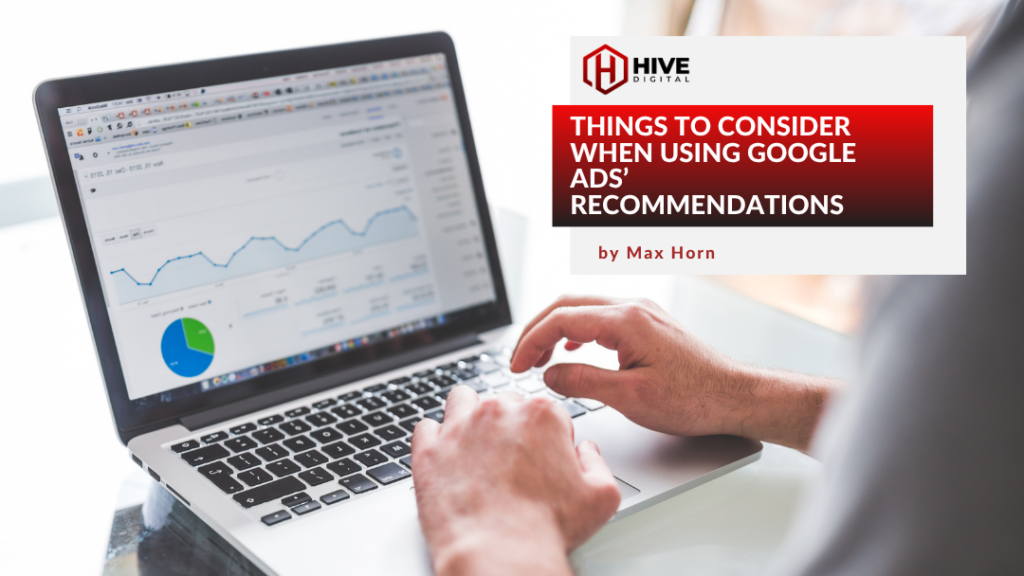
If you’ve spent any time in Google Ads, you’ve probably seen the Recommendations tab filled with suggestions designed to improve your account. Some recommendations can be helpful. Others can significantly change how your campaigns operate. The key is understanding that a recommendation is exactly that, a recommendation, not a requirement.
Broad Data vs. Your Unique Goals
One of the biggest misconceptions I see among advertisers is the belief that Google’s recommendations are automatically in the advertiser’s best interest. While Google provides valuable tools and insights, its recommendations are based on broad platform data and automation opportunities. They are not based on your unique business goals, profit margins, lead quality, or sales process. While it is true that Google Ads is an auction, and you must pay to play, sometimes, it’s not about spending more, it’s about wasting less.
Before applying any recommendation, it’s important to ask a few simple questions:
- Why is Google recommending this?(Is it to increase my spend, or genuinely improve my ROI?)
- Does this change align with my specific target audience?
- How will this impact my current budget and cost per acquisition?
- If it goes wrong, how easy is it to undo?
Common Recommendations (And What They Actually Mean)
For example, Google may recommend adding Broad Match keywords. In the right campaign, Broad Match keywords can be incredibly effective and help uncover new opportunities. In the wrong campaign, it can increase spend on searches that are less qualified or outside your target audience. The recommendation itself is not inherently good or bad. Its value depends entirely on the context of your business and campaign objectives.
The same principle applies to budget increase recommendations. Google often identifies campaigns that are limited by budget and suggests increasing spend. While additional budget may generate more traffic, that does not automatically mean it will generate more profitable traffic. Before increasing a budget, advertisers should evaluate lead quality, conversion rates, and return on ad spend to determine whether additional investment makes sense.
Weighing the Pros and Cons of Automation
Another area where caution is warranted is automated campaign settings. Recommendations related to automatically created assets, audience expansion, or automated targeting can sometimes improve performance. However, they can also reduce the level of control advertisers have over messaging and targeting. If your business operates in a highly competitive industry or relies on strict messaging guidelines, blindly accepting these recommendations can create unintended consequences.
Consider Suggestions, But Validate Them With Your Own Experience and Data
One of the most important realities of modern PPC is that there is rarely a single right or wrong answer anymore. Platforms are increasingly powered by automation and machine learning. Success often comes from providing strong inputs, monitoring results, and adapting based on performance. Google’s recommendations should be viewed through that same lens.
Think of Google’s automation like autopilot on an airplane. The system can handle much of the flying, but it still needs a pilot. Recommendations can provide useful direction, but they should never replace strategic decision-making. Your role as the advertiser is to evaluate whether a recommendation aligns with your business goals before applying it.
Stay on the Cutting Edge with AI Services
AI is changing the way people search, learn, and buy... Hive is ready for the digital evolution. Our team of expert AI engineers can help you stay visible in new search spaces like generative search engines and AI overviews. We can also help empower your business to use AI solutions for enhanced marketing efficiency and impact.
Discover Hive AI Services“Sometimes, it’s not about spending more, it’s about wasting less.”
In my experience, the most successful advertisers don’t automatically reject Google’s recommendations, nor do they blindly accept them. Instead, they evaluate each recommendation individually, test when appropriate, and make decisions based on data rather than platform suggestions alone.
Understanding the Real Impact
The Recommendations tab should be treated as a source of ideas, not a checklist to complete.
Some recommendations can uncover real opportunities, while others may increase spend, broaden targeting, or shift campaign behavior in ways that do not align with your business goals. The key is understanding the potential impact before making any change and ensuring every recommendation supports your broader marketing strategy. At the end of the day, Google understands Google’s platform. You understand your business. The best results happen when those two perspectives work together.
Making Sense of the Machine
If you are unsure which recommendations are worth implementing, the team at Hive Digital can help. Whether it’s Google Ads, SEO, or your overall strategy, our goal is to help you cut through the platform noise. We love getting into the weeds with our clients to find the actual, data-backed moves that make sense for your specific goals. Rather than relying on automated suggestions alone, we combine technology with human expertise to help clients make smarter marketing decisions, improve performance, and maximize return on investment. Whether you need a second opinion on your Google Ads account or a comprehensive digital marketing strategy, Hive Digital is here to help.