Google Ads has spent the last decade pushing advertisers toward automation. Performance Max may be the clearest example of such: provide Google your goals, assets, audiences, search themes and budget, then allow the machine to determine where the next conversion is most likely to happen. For better or worse, control over copy combinations and insight into ad triggers are limited at best.
Thankfully, Google’s Demand Gen campaign takes on a slightly different approach.
Performance Max and Demand Gen are sometimes lumped together as Google’s automated, multi-channel campaign types, yet they are rarely interchangeable. Yes, technically there is overlap but strategically, they perform very different jobs. Neither is inherently better, the question is what you are trying to accomplish. In this article, we review what makes each campaign special.
Key Takeaways
- Different Jobs, Same Ecosystem: Performance Max captures active, high-intent demand across Google channels. Demand Gen builds future demand on visual, feed-based placements.
- Intent vs. Audience: PMax leverages active Google Search behavior. Demand Gen relies on creative, audience targeting, and first-party seed data to drive discovery.
- The Growth Strategy: High-performing accounts don’t pick one over the other—they use Demand Gen to widen the top of the funnel and Performance Max to harvest the conversions at the bottom.
Performance Max Starts With Intent
Performance Max has one enormous advantage that Demand Gen cannot replicate: Google Search.
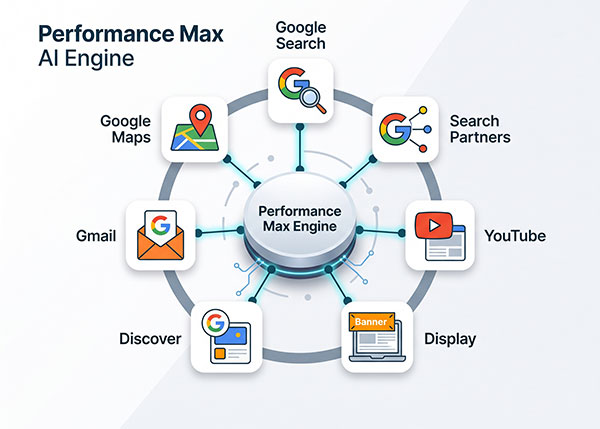
PMax can serve across Search, Search Partners, YouTube, Display, Discover, Gmail and Maps, allowing Google to move budget throughout its ecosystem based on the probability of reaching a campaign’s conversion objective.
Google Ads 101: Decoding the Google’s Inventory Ecosystem |
| Google Search: High-intent text ads triggered directly by user search queries on Google.com. |
| Search Partners: A network of non-Google websites and smaller search engines partnered with Google to extend search reach. |
| Search Partners: A network of non-Google websites and smaller search engines partnered with Google to extend search reach. |
| YouTube & Shorts: Video and feed-based placements embedded directly within YouTube content and full-screen vertical Shorts. |
| Google Display Network (GDN): Visual banner and native ad placements spanning millions of third-party websites and mobile apps. |
| Discover: The visual, personalized content feed on the Google mobile app homepage and Android devices. |
| Gmail: Native image and text ads displayed directly inside user email inboxes under the Promotions and Social tabs. |
| Google Maps: Promoted local listings and pins displayed directly within Google Maps desktop and mobile navigation. |
The Search access fundamentally changes the campaign. Someone searching for “emergency plumber near me,” “CPA firm broker” or “buy bridesmaid dresses online” is already telling Google something extraordinarily valuable: I am interested in this right now. Performance Max can capitalize on that intent and then use Google’s other channels to support the conversion journey.
Search themes make this even more useful. They allow advertisers to provide additional clues about the types of searches and customer intent that matter to the business. But the important word here is signal.
We’re giving Google directions, not drawing the entire map.
The same concept applies to audiences. Performance Max audience signals can help Google understand what a valuable customer might look like, but Google is free to move beyond those audiences when its models predict another user is more likely to convert. Google explicitly describes these audiences as signals rather than hard targeting. That’s exactly what makes PMax powerful.
The Price of Automation Is Control
Performance Max operates around a straightforward bargain: give Google more structural freedom and, theoretically, the algorithm will find more cost-effective conversions.
But just be aware, the tradeoff is that advertisers surrender some tactical control.
You can build strong asset groups, improve feeds, provide search themes, refine audiences, exclude poor traffic and strengthen conversion data. But you cannot micromanage every auction, asset combination or channel allocation the way you might in a tightly segmented traditional search campaign structure.
Google Ads 101: Asset Groups vs. Traditional Ads |
| In traditional Search campaigns, you write specific text ads tied to explicit keywords. In Performance Max, you build Asset Groups—baskets of headlines, descriptions, images, logos, and videos. Google’s AI dynamically mixes, matches, and tests these assets across different placements to see which combination yields the highest conversion rate. |
But Google has improved transparency significantly. Performance Max now provides channel level performance reporting showing how campaigns perform across Search, YouTube, Display, Discover, Gmail, Maps and other eligible inventory. That’s a major improvement. But visibility and control are two different things.
Google may show me that a campaign is generating substantial activity from Search. That does not mean I can simply tell PMax, “Great. Put another 20% of the budget there.” Ideally, the algorithm is intuitive enough to do this, but we are not controlling the channel steering wheel.
Placements are selected on a campaign level, if eligible, and each group requires the same image and video ratios. There are ways to influence the placement of assets, such as limiting the images or videos in the asset group or adding new ones, however, Google’s interface will downgrade the asset group rank simply based on this.
Demand Gen Flips the Search Strategy
Demand Gen begins somewhere else entirely. This campaign type does not show on search. Without search terms, Google needs some type of reference signal, otherwise, showing an ad is like playing darts with a blindfold on.
The campaign still relies heavily on Google’s machine learning, but it opens the net and gives advertisers considerably more influence over who they want to reach, where they want to reach them and what creative experience those users see.
Advertisers can choose channels at the ad-group level, including YouTube in-stream, YouTube in-feed, Shorts, Discover, Gmail, Maps and the Google Display Network. That is a significant strategic difference from Performance Max. If I’ve created a vertical video specifically for Shorts, I can build around Shorts. Creative elements can be set on an ad level so if you only want to show an image ad or just a YouTube shorts video within an ad group, Google allows for this.
Creative becomes part of the targeting strategy instead of simply another collection of ingredients fed into the machine.
Google Ads 101: First-Party Seed Data |
| First-party data refers to proprietary customer information you own directly (like CRM contact lists, email subscribers, or purchase history). Uploading this data as a “seed list” gives Google’s AI a precise template of your ideal customer profile. |
In addition, advertisers can build audiences around first-party data, interests, custom segments, demographics and Lookalike segments. Audience strategies can be separated at the ad-group level, allowing different creative approaches for different customer groups.
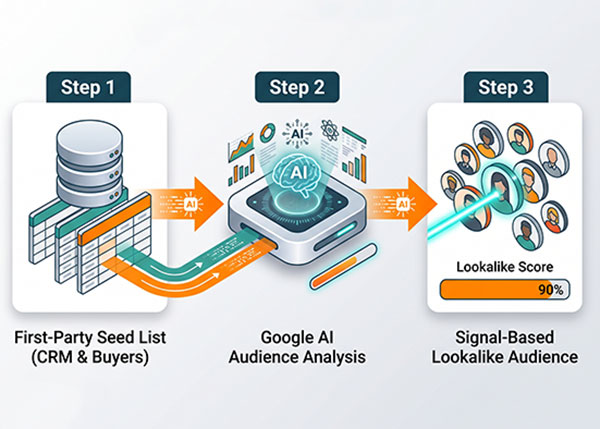
Provide Google Ads with a strong first-party seed audience (customers, subscribers, high-value users or another meaningful list) and Google can find users exhibiting similar characteristics. That distinction is changing somewhat. During 2026, Google is transitioning Demand Gen Lookalikes toward a more signal-oriented model, where the seed increasingly guides the algorithm rather than functioning as a rigid audience boundary.
That makes high-quality first-party data increasingly valuable across both campaign types.
Demand Gen Also Gives You More Ways to Define Success
Demand Gen has another advantage: bidding flexibility.
Depending on the campaign objective, advertisers can use strategies including Maximize Clicks, Maximize Conversions, target CPA, Maximize Conversion Value and target ROAS. Google has also expanded Demand Gen into objectives involving YouTube engagement, including channel subscriptions and follow-on views.
That opens the door to something PPC advertisers sometimes forget – Not every campaign needs to close the sale immediately.
Demand Gen excels at:
- Introducing your brand to new prospective audiences.
- Driving qualified top-of-funnel traffic.
- Building high-intent remarketing audiences.
- Showcasing visual product catalogs.
- Educating prospects on a problem they haven’t yet actively searched for.
Search, Performance Max, or standard remarketing campaigns can then harvest that captured demand further down the funnel.
This makes Demand Gen particularly interesting for brands with strong video and visual creative. If nobody knows your product exists, obsessing over bottom-of-funnel Search alone eventually creates a ceiling.
You cannot capture demand that has not been created.
So Which One Should You Use?
Choosing between Performance Max and Demand Gen is usually the wrong framing. The reality is that for many advertisers, these strategies should work together.
Performance Max can harvest existing intent across Google’s ecosystem. Demand Gen can introduce the brand to the audiences most likely to become future customers. Think of the literal sales funnel. Demand Gen widens the opening. Performance Max helps collect what’s moving toward the bottom.
If I’m managing an established ecommerce company with strong brand demand, Merchant Center data and substantial conversion history, Performance Max may become one of the core revenue engines.
If I’m launching something without existing reach, PMax alone may struggle to manufacture enough incremental demand.
That’s where Demand Gen becomes considerably more interesting. Use Demand Gen to test audiences, creative concepts, YouTube placements and prospecting strategies. Then allow Search and Performance Max to capture the higher-intent behavior that follows. The future of PPC isn’t choosing between automation and control. It’s knowing where automation deserves freedom and where the advertiser still needs to provide direction.
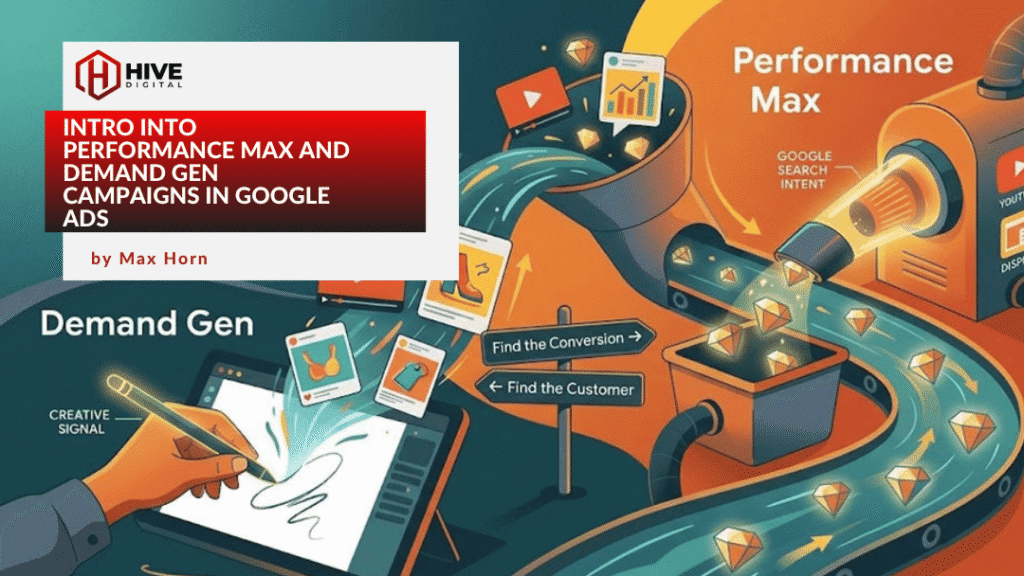
Performance Max says, Find me the conversion.
Demand Gen says, Find me the customer who could become one.
Try Out Autopilot, But Keep One Hand on the Wheel
Navigating Google’s automated ecosystem doesn’t mean handing over the keys completely, it’s about knowing where to give the machine room to optimize and where to enforce human strategy. If you’re looking to refine your paid media architecture or build a full-funnel search strategy, reach out to the Hive Digital team to see how we can help.