A fundamental shift is happening in the way people interact with search engines. When a user engages with a modern informational system, whether that’s Google’s AI Overviews or a conversational LLM (ChatGPT, Claude, Gemini, etc.), they are rarely running a simple, singular lookup. This shift is also reflected in the reduced power that individual keyword phrases hold in the search engine optimization world, as these phrases are now understood more to be topic clusters that include a wide variety of keywords. The new method that users have been adopting are utilizing a deep, multi-layered retrieved process known as Query Fan-Out Method or Query Fan-Out Technique.
At Hive Digital, we view this as the most significant development in our industry right now, and it demands a transition from strategies built on individual keyword rankings to those focused on completed topical command. To succeed, our content framework must align with the mechanical reality of how these systems assemble answers.
What is Query Fan-Out?
The Query Fan-Out Method is the process where modern AI-powered search (like Google’s AI Overviews) breaks a single, broad user question into many specific, simultaneously derived queries (sub-questions) to gather content.
To understand this technical process, imagine a head chef tasked with creating a signature dish. The request “Make the Signature Risotto” is a high-level command, but executing it requires dozens of specific, simultaneous checks and preparations.
This is the essence of the Query Fan-Out Method. The search system takes a broad user question and puts it through a rigorous breakdown:
- The Input (The Desired Outcome): A user asks a multifaceted question (EG: “What are the most durable and cost-effective flooring materials for a high-traffic retail space?”).
- The Fan-Out (The Recipe Breakdown): The core system does not search for that long string of text. Instead, it dissects the input into many smaller, highly specific informational requests, commonly referred to as derived queries, that are executed at the same time.
- Content Retrieval (The Ingredient Sourcing): For each specific derived query, the system scans its index to find a relevant content “passage” or “section” to serve as a high-quality ingredient.
- The Assembly (The Final Dish): A central synthesis engine combines the highest-quality, most authoritative passages retrieved to form a single, comprehensive response.
The Objective: Your goal is to provide a specific, top-tier “ingredient” (content passage) for every distinct check the system makes. The more facets you cover with demonstrably authoritative content, the higher the probability your website is included as a primary source.
Strategic Command: Targeting “Unrecorded” Needs
To influence the fan-out process, your content plan must align with the specific type of requests the system generates.
Seer Interactive put together a study that indicates that a vast majority, up to 95%, of the derived informational requests created by the system are not recorded in standard SEO tools. These are implicit informational needs, questions the system anticipates the user will have, even if the user didn’t explicitly ask them.
Focus on the Informational Journey
The only way to capture these unrecorded needs is by shifting focus from isolated keywords to the entire informational journey.
If a homeowner is searching for insights on “planning a complete kitchen remodel in a small house,” the fan-out mechanism will generate derived requests covering:
- Financials: “Average cost of replacing kitchen cabinetry and appliances.”
- Logistics/Compliance: “Do I need a permit for minor plumbing and electrical changes in a residential kitchen?”
- Materials: “Pros and cons of quartz versus granite countertops for high-traffic use.”
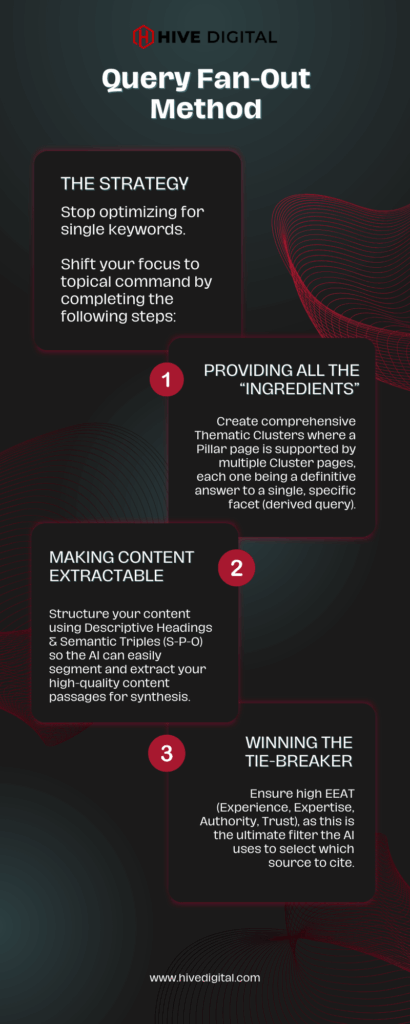
Actionable Strategy: Organize your content into Thematic Clusters. Create a Pillar page (the main theme) and support it with multiple Cluster pages (the specific ingredients). Each Cluster page should be a definitive answer to a single facet, maximizing your potential to address the widest range of derived queries.
As Mike King noted at Tech SEO Connect, we cannot control how the system synthesizes the final answer, but we have total control over the inputs. The more high-quality inputs (content facets) we provide, the better our odds of being selected for the final assembly.
Optimization Tactics: Structuring Content for Assembly
The informational system does not “read” your content like a human; it extracts knowledge patterns. Your content architecture is the primary factor in ensuring it can be correctly sourced.
Optimize for Passage Segmentation
The system processes content by breaking it into discrete, context-aware passages or sections. To ensure your passage is selected, you must provide clear structural markers.
- Descriptive Headings: Use H2s and H3s that are specific and directly state the answer the user might seek (EG: instead of “Testing,” use “Durability Test Results for Epoxy Flooring”). The internal hierarchy of your headings provides necessary context for the selected passage.
- Semantic Precision: Construct sentences using semantic triples (Subject–Predicate–Object structure) and clear entities. This explicit structure makes your data unambiguous and easy for the system to extract during assembly.
- Example:
- User’s Main Query: “Make the Signature Risotto” (Implicit Request)
- Derived Fan-Out Query: “What is the proper stock-to-rice ratio?”
- Content Designed for Extraction: Arborio Rice (Subject) Requires (Predicate) Four Cups of Hot Chicken Stock (Object)
- The S-P-O structure isolates a key ingredient (Rice) and its essential preparation fact (Stock Ratio) without extraneous details.
- Example:
- Use Digestible Formats: Present specific data points using bulleted lists, numbered steps, and HTML tables. These structured formats are ideal for the system when extracting clean, concise data for the final answer.

Authority and Trust as the Decisive Filters
Once the system has retrieved a relevant passage, traditional search position often becomes a secondary metric. The comparison process relies heavily on established quality signals: Experience, Expertise, Authority, and Trust (EEAT).
High Authority and Trust serve as the tie-breaker. When two passages offer similar relevance, the one from the source demonstrating the strongest credentials and reputation will be prioritized.
- Demonstrate Expertise: Feature original research and credit content to authors with visible, relevant professional backgrounds.
- Content Ecosystem Strategy: Recognize that the informational system pulls context from across the web. An omnimedia strategy ensures your authority is consistently reinforced across forums, technical reviews, and video platforms, bolstering the overall trust signal for your domain.
By combining deep strategic planning with a technical understanding of the Query Fan-Out Method, your site becomes the certified Master Chef, the essential, high-quality supplier of every ingredient the system needs for a definitive response.
Stop hoping for visibility. Start engineering it. Connect with our experts and get cited.